Email marketing consistently delivers the highest ROI of any digital channel — roughly $36–$42 return for every $1 spent, according to industry benchmarks. But the platform you choose determines whether that ROI materialises or evaporates in deliverability issues, clunky automation, and unexpected pricing jumps.
We spent time testing these platforms hands-on, reviewing verified user feedback from G2 and Capterra, and comparing pricing, deliverability infrastructure, automation depth, and ease of use to give you the most accurate picture for 2026.
Further reading: MailerLite vs Mailchimp.
Table of Contents
How We Evaluated These Tools
Not all email marketing platforms are built equally. Here is the criteria framework we used to score and rank every tool in this guide:
- Deliverability: sender reputation, shared vs dedicated IP infrastructure, SPF/DKIM/DMARC support
- Automation depth: trigger logic, conditional branching, multi-step sequences
- Ease of use: drag-and-drop builder quality, template variety, learning curve
- Pricing transparency: cost per 1,000 contacts, free plan limitations, pricing tier jumps
- Integrations: native CRM, ecommerce (Shopify, WooCommerce), and CMS connections
- Support quality: live chat availability, documentation depth, onboarding help
- G2 / Capterra ratings: verified user reviews as a third-party signal
Editorial note: Mailercloud is the platform behind this blog. We have listed it as one option among many and applied the same evaluation criteria to it as every other tool. We encourage you to compare independently.
Quick Comparison: 18 Best Email Marketing Platforms (2026)
UPDATED MARCH 2026 · 18 TOOLS COMPARED
| Tool | Best For | Free Plan | Price From | Standout Feature |
|---|---|---|---|---|
| Mailercloud | SMBs & startups | Yes | $7 / mo | AMP emails + automation on free plan |
| Brevo | CRM + automation on a budget | Yes | $9 / mo | Volume-based pricing — unlimited contacts |
| Mailchimp | Brand recognition & integrations | Yes | $13 / mo | 800+ native integrations |
| ActiveCampaign | Advanced automation | No | $15 / mo | Most powerful automation builder available |
| MailerLite | Simplicity & value | Yes | $10 / mo | 1,000 contacts free + landing pages |
| Klaviyo | Ecommerce (Shopify / WooCommerce) | Yes | $20 / mo | Deep ecommerce data — CLV, browse, cart |
| Omnisend | Ecommerce + SMS | Yes | $16 / mo | Email + SMS + push in a single workflow |
| Constant Contact | Nonprofits & events | No | $12 / mo | Event registration & ticketing built in |
| GetResponse | Funnels + landing pages | Yes | $19 / mo | Full funnel builder + website + webinars |
| HubSpot | CRM-first teams | Yes | $20 / mo | Free CRM with 1M contacts + deal tracking |
| ConvertKit (Kit) | Creators & newsletters | Yes | $33 / mo | 10,000 free subscribers + paid newsletter tools |
| Beehiiv | Newsletter publishers | Yes | $42 / mo | Built-in growth engine + web publication |
| AWeber | Phone support & templates | Yes | $12.50 / mo | Phone support on all paid plans + 700+ templates |
| Moosend | Budget + pro automation | Yes | $9 / mo | Pro features at below-average pricing |
| SendPulse | Multichannel messaging | Yes | $8 / mo | 15,000 free emails/mo + SMS + push + Viber |
| Mailjet | High-volume sending | Yes | $15 / mo | Unlimited contacts on all plans |
| Zoho Campaigns | Zoho CRM users | Yes | $5 / mo | Native Zoho CRM sync + 5 users on free plan |
| CleverReach | EU GDPR compliance | Yes | €15 / mo | EU-hosted infrastructure — GDPR-first design |
Pricing based on entry-level paid plans as of March 2026. Free plan availability subject to change.
Detailed Reviews
Below is an in-depth look at each platform — what it does well, where it falls short, who it is best suited for, and what it costs.
1. Mailchimp — Best for Brand Recognition & Integrations

Mailchimp remains the most recognised email marketing name globally, with over 11 million users. Its ecosystem of 800+ native integrations — from Shopify to Salesforce — is unmatched. However, its free plan has been significantly scaled back in recent years. Automation is now paywalled, the daily sending cap is restrictive, and pricing scales steeply as your list grows past 1,500 contacts.
For teams already embedded in tools that integrate natively with Mailchimp, the switching cost is real. For everyone else, there is likely better value elsewhere.
| Free plan | Yes — 500 contacts, 1,000 emails/month |
| Starting price | $13/month (Essentials) |
| G2 rating | 4.3 / 5 (12,000+ reviews) |
| Best for | Teams that prioritise a well-known brand and wide integration ecosystem |
2. Brevo (formerly Sendinblue) — Best for Budget-Friendly CRM + Automation
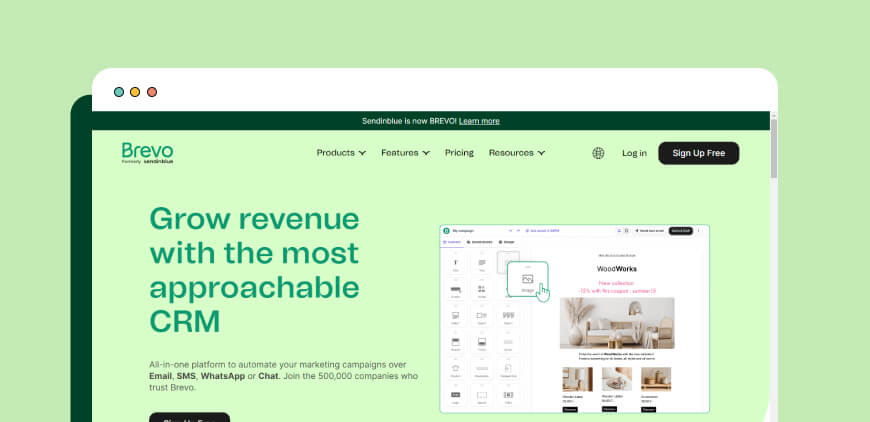
Brevo’s key differentiator is its pricing model: you pay for emails sent, not contacts stored. That means you can hold 100,000 contacts on the free plan without paying a penny — a significant structural advantage over Mailchimp, MailerLite, and others who charge by list size. See the two platforms go head-to-head in our Brevo vs Mailchimp breakdown.
The platform includes a built-in CRM, transactional email capabilities, SMS marketing, and WhatsApp messaging. The automation builder is capable, with website tracking triggers and 12 pre-built workflow templates. Where Brevo falls short is template design — only 40+ templates versus Mailchimp’s 100+ — and no access to advanced reporting on the free plan.
| Free plan | Yes — unlimited contacts, 300 emails/day (9,000/month) |
| Starting price | $9/month (Starter — 5,000 emails/month) |
| G2 rating | 4.5 / 5 (4,500+ reviews) |
| Best for | Growing businesses that want automation and CRM without paying per contact |
3. Omnisend – Best for Ecommerce Multichannel Automation
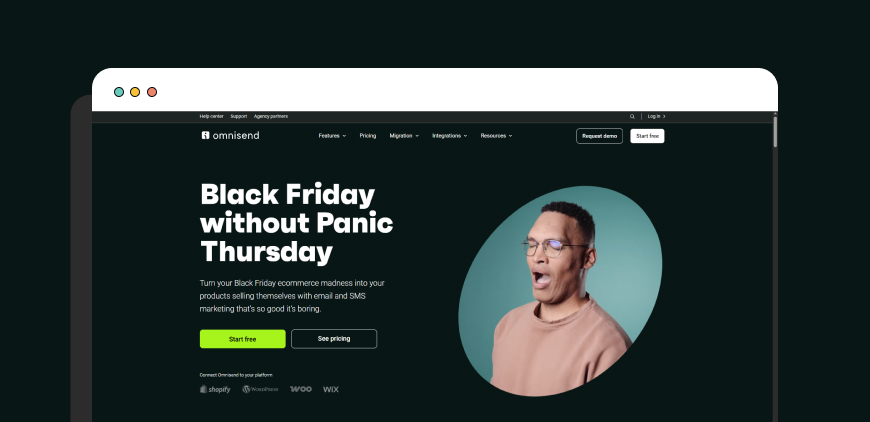
Omnisend is built specifically for online retail. Product pickers, abandoned cart workflows, order confirmation sequences, and gamified forms (spin-the-wheel popups) are all available. SMS and web push notifications are included in the same workflows as email, making true multichannel orchestration possible without a second tool.
The free plan is quite limited in send volume, and the platform is at its best for ecommerce — non-retail use cases feel underserved by the feature set. Pricing is competitive versus Klaviyo for growing stores.
| Free plan | Yes — 250 contacts, 500 emails/month |
| Starting price | $16/month |
| G2 rating | 4.5 / 5 (900+ reviews) |
| Best for | Small-to-mid ecommerce stores wanting email + SMS + push in one platform |
4. Mailmodo – Best for AI-Powered Email Marketing & Interactive Emails

Mailmodo is an AI email marketing software designed for businesses that want to automate campaign creation, email design, customer journeys, and optimization from one place. Unlike traditional email tools that focus mainly on sending campaigns, Mailmodo utilizes AI Agents to help marketers create and launch campaigns more efficiently with reduced manual work. Teams looking to extend AI beyond email execution are also adopting AI agent platforms that automate revenue operations, customer workflows, and cross-functional business processes. Rox is one such platform focused on agentic AI for enterprise workflow automation.
| Free plan | Yes — Forever free plan with basic features and AI features included |
| Starting price | $27/month (Lite) |
| G2 rating | 4.6 / 5 |
| Best for | Startups, SaaS brands, and marketing teams looking for AI-powered email marketing, automation, and interactive emails. |
5. ActiveCampaign — Best for Advanced Automation
ActiveCampaign is the go-to platform for marketers who need genuinely advanced automation — conditional logic, lead scoring, CRM deal pipelines, site tracking, and predictive sending. The automation builder is the most powerful in this list for complex multi-step sequences tied to user behaviour.
The trade-off is cost and complexity. There is no free plan, the interface has a learning curve, and pricing moves up quickly with contact count. For small businesses with simple needs, it is overkill. For SaaS companies running multi-touch nurture sequences, it pays for itself. For a deeper look at email strategy for smaller teams, see our small business email marketing guide.
| Free plan | No — 14-day free trial (no credit card required) |
| Starting price | $15/month (Starter — 1,000 contacts) |
| G2 rating | 4.5 / 5 (13,000+ reviews) |
| Best for | Mid-sized businesses needing deep CRM integration and behaviour-based email sequences |
6. Klaviyo — Best for Ecommerce (Shopify & WooCommerce)
Klaviyo is purpose-built for ecommerce. Its deep integrations with Shopify pull in purchase history, browse behaviour, product data, and predictive lifetime value — enabling segments and triggers that generic tools simply cannot match. Abandoned cart, post-purchase, winback, and product replenishment flows are best-in-class. For a deeper dive into the flows that drive ecommerce revenue, see our ecommerce email marketing strategies. For Shopify merchants who have grown beyond a single-vendor store, building a multi-vendor marketplace on Shopify allows them to onboard multiple sellers, automate order routing, and manage payouts, creating a larger product catalog for email marketing campaigns to promote.
The cost, however, is the main concern for smaller stores. At 10,000 contacts you are paying $150/month, and pricing continues to scale steeply. Teams on tight budgets often start with Klaviyo’s free plan, then switch to a more affordable tool once costs mount.
| Free plan | Yes — 500 contacts, 500 emails/month + 150 SMS credits |
| Starting price | $20/month (500 contacts, email only) |
| G2 rating | 4.6 / 5 (1,200+ reviews) |
| Best for | Ecommerce brands on Shopify, WooCommerce, or BigCommerce focused on revenue automation |
7. SendPulse — Best for Multichannel Messaging
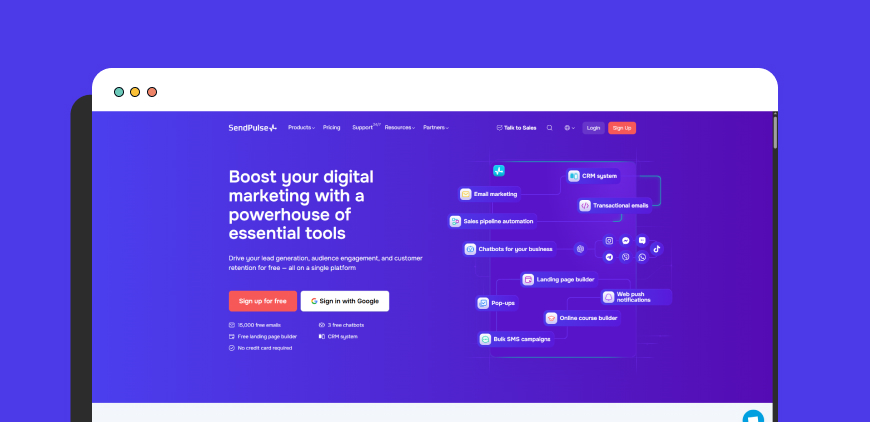
SendPulse’s free tier covers up to 500 subscribers and 15,000 emails per month — one of the more generous limits among platforms in this category. Where it really stands out is breadth: its email marketing platform with built-in CRM sits alongside SMS, and chatbot builders for WhatsApp, Telegram, Instagram, Facebook Messenger, and Viber — all accessible from a single dashboard without external integrations.
The trade-off is depth. Automation workflows are more straightforward than what ActiveCampaign offers, and the interface can feel cluttered when managing multiple channels at once. But for teams that want multichannel reach without paying for separate tools, the value proposition holds up. See the two compared directly in our ActiveCampaign vs Klaviyo breakdown.
| Free plan | Yes — 500 contacts, 15,000 emails/month |
| Starting price | $9.85/month |
| G2 rating | 4.6 / 5 (714 reviews) |
| Best for | Businesses wanting email, SMS, web push, and chatbots from a single platform |
8. MailerLite — Best for Simplicity and Value
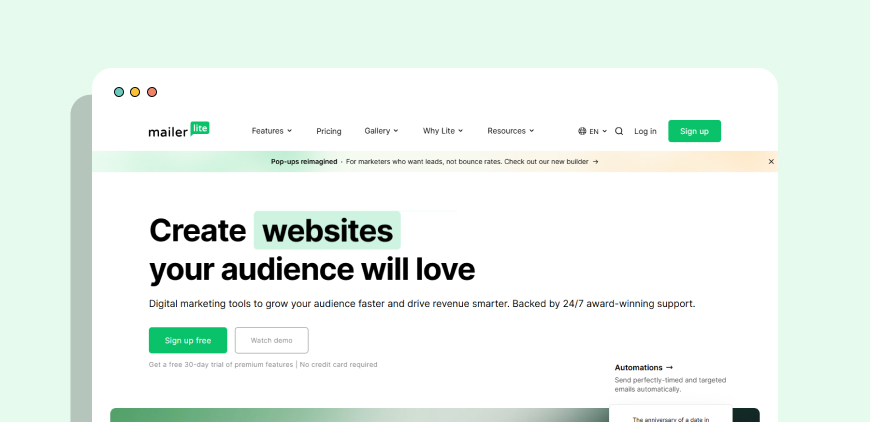
MailerLite consistently earns top marks for ease of use. The interface is clean, the drag-and-drop builder is polished, and the free plan is genuinely generous — 1,000 subscribers and 12,000 sends per month. The platform includes landing pages, website builder, automation, and pop-up forms even on lower tiers. (For a full comparison, see our MailerLite alternatives roundup.)
Weaknesses include a strict account approval process that some users have found frustrating, no template access on the free plan, and thinner advanced analytics than ActiveCampaign or Klaviyo. For straightforward email marketing needs, however, few platforms beat the value.
| Free plan | Yes — 1,000 contacts, 12,000 emails/month |
| Starting price | $10/month |
| G2 rating | 4.7 / 5 (1,000+ reviews) |
| Best for | Small businesses and solopreneurs who want a clean, easy platform without overpaying |
9. Mailercloud — Best for AMP Emails and Affordable Automation
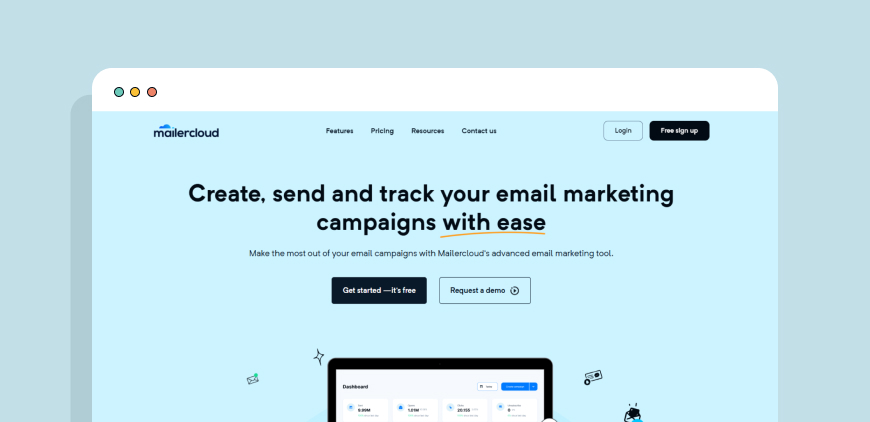
Mailercloud stands out in two areas: AMP email support (interactive emails that load dynamic content inside the inbox without the recipient clicking away) and a competitive pricing model that keeps advanced features accessible from lower tiers. The drag-and-drop builder is solid, the automation engine supports multi-step sequences with conditional logic, and the free plan includes web forms and automation — features that are paywalled on Mailchimp and MailerLite.
The main limitations are a smaller third-party integration library compared to Mailchimp or ActiveCampaign, a newer brand with less social proof than established players, and click tracking data that can require manual verification in the dashboard. The platform is actively growing and integrations are being added regularly.
| Free plan | Yes — includes automation and web forms |
| Starting price | $7/month (1,000 contacts) |
| G2 rating | See Capterra and Software Advice listings |
| Best for | Startups, SMBs, and SaaS teams wanting advanced automation at a lower price point |
10. HubSpot — Best Free CRM + Email Combination
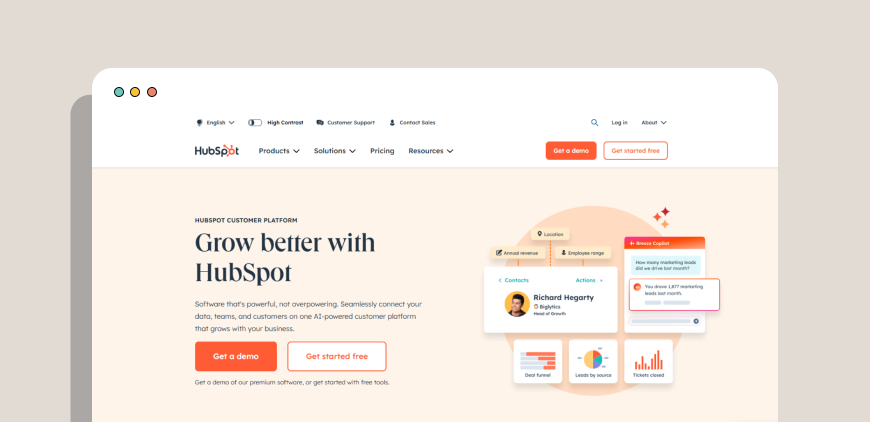
HubSpot’s email tool is at its best when used alongside the HubSpot CRM, which is free for unlimited users and stores up to 1 million contacts. The combination gives you a complete view of the customer journey — from first email open to closed deal — without switching platforms. For sales-led businesses, this is a significant advantage — for a detailed breakdown, see our our HubSpot vs Mailchimp breakdown.
The free email plan caps at 2,000 sends per month, which limits its usefulness for campaigns at any meaningful scale. Moving to a paid plan is a notable cost jump, and the platform is more complex than MailerLite or Brevo for straightforward email needs.
| Free plan | Yes — 2,000 emails/month, 1 million contacts |
| Starting price | $20/month (Marketing Hub Starter) |
| G2 rating | 4.4 / 5 (12,000+ reviews) |
| Best for | Teams that need a CRM and email marketing in one place from day one |
11. GetResponse — Best for Funnels and Landing Pages
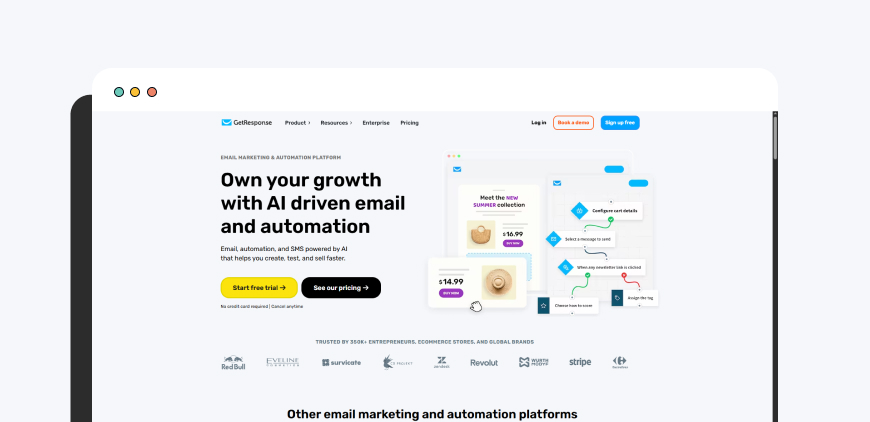
GetResponse has evolved into a full marketing stack. Beyond email, you get a website builder with SEO tools, a conversion funnel builder, landing pages, and webinar hosting on higher tiers. The free plan includes a website builder and signup forms alongside basic email marketing. If GetResponse isn’t the right fit, see our GetResponse alternatives guide.
The breadth of features can make the platform feel unfocused — email marketers who just want a clean campaign tool may prefer MailerLite or Brevo. Where GetResponse earns its place is for teams building lead generation funnels where multiple components (opt-in page, email sequence, thank-you page) need to work together seamlessly. In larger marketing teams, those assets are often created by different stakeholders, with writers, designers, marketers, and clients contributing throughout the process.
| Free plan | Yes — 500 contacts, 2,500 emails/month |
| Starting price | $19/month |
| G2 rating | 4.2 / 5 (700+ reviews) |
| Best for | Businesses running lead-gen funnels that want email + landing pages in one tool |
12. ConvertKit (Kit) — Best for Creators and Newsletter Monetisation
ConvertKit rebranded as Kit in 2023 and doubled down on the creator economy. Its free plan is unusually generous — 10,000 subscribers with unlimited sends and a recommendation engine to grow your audience through cross-promotions. Paid plans add paid newsletter subscriptions, digital product sales, and audience referral tools.
The platform is optimised for simplicity and creator workflows rather than complex marketing automation. If you need deep CRM logic, behaviour-based triggers, or ecommerce integration, other platforms will serve you better. If you write a newsletter and want to earn money from it, Kit is the best tool available.
| Free plan | Yes — 10,000 subscribers, unlimited emails |
| Starting price | $33/month (Creator plan) |
| G2 rating | 4.4 / 5 (200+ reviews) |
| Best for | Writers, podcasters, and content creators wanting to build and monetise an audience |
13. Beehiiv — Best for Newsletter Publishers
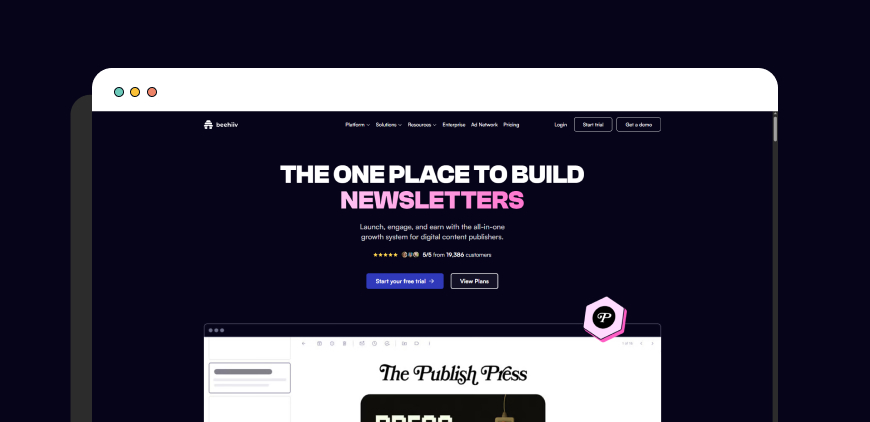
Beehiiv was built from the ground up for newsletter publishing, by former Morning Brew team members. It combines email, a web publication (think Substack), audience analytics, and a referral/recommendation network in one. The free plan allows up to 2,500 subscribers with unlimited sends and custom domain support.
Paid plans are at the higher end of the market, and there is no email automation on any tier — Beehiiv is a publishing tool, not a marketing automation platform. For anyone building a standalone newsletter business, it is the most purpose-built option available. For traditional email marketers, it is too limited. For a closer look at that trade-off, see how Beehiiv compares to Mailchimp.
| Free plan | Yes — 2,500 subscribers, unlimited emails |
| Starting price | $42/month (Scale plan) |
| G2 rating | Newer platform — limited review volume |
| Best for | Journalists, media brands, and newsletter-first businesses |
14. AWeber — Best for Phone Support and Template Variety
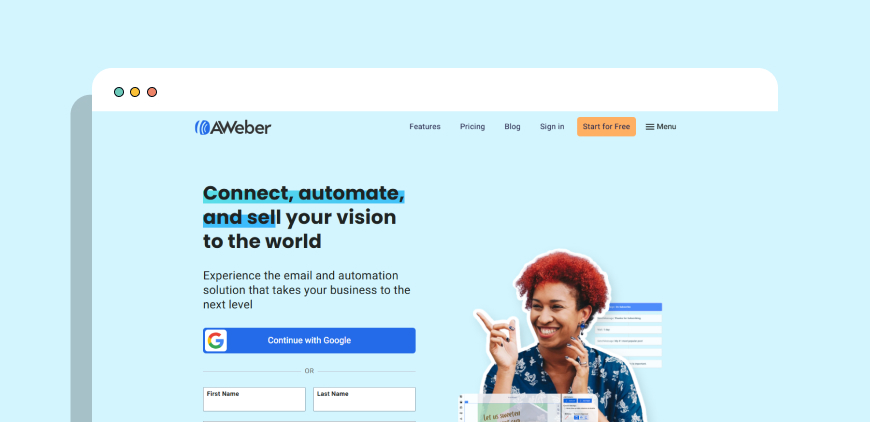
AWeber is one of the oldest email platforms, founded in 1998. It has maintained relevance through strong customer support — including phone support on all paid plans, which is rare — and a large library of pre-built templates. The platform is stable and reliable, and the automation tools cover most standard use cases well.
Its weaknesses are its age showing in parts of the UI, thin analytics compared to modern platforms, and a contact limit of one list per account. For affiliate marketers who need phone support or value design variety, AWeber remains a solid option. The full AWeber vs Mailchimp rundown covers how it fares against its biggest rival.
| Free plan | Yes — 500 subscribers, 3,000 emails/month |
| Starting price | $12.50/month |
| G2 rating | 4.2 / 5 (600+ reviews) |
| Best for | Marketers who prioritise customer support access and a rich design template library |
15. Constant Contact — Best for Nonprofits and Event Marketing
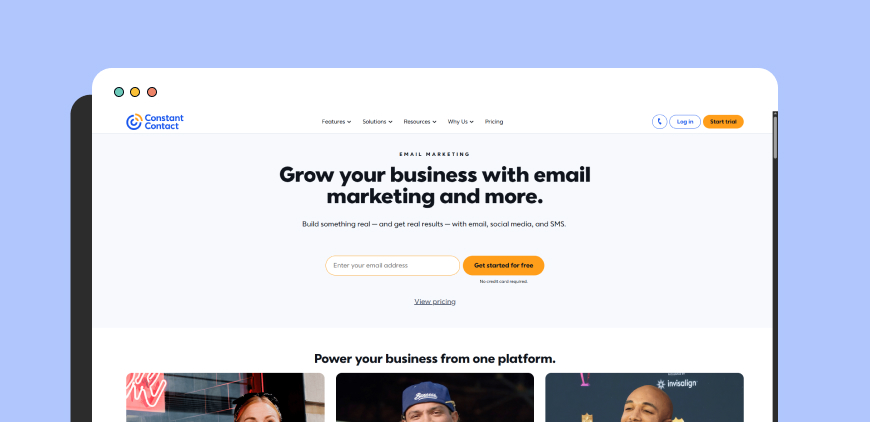
Constant Contact has niche strengths that keep it relevant: built-in event management tools (registration, ticketing, RSVP tracking), strong nonprofit programme pricing, and a reputation for accessible customer service. It is often the platform recommended by nonprofit technology consultants for smaller organisations.
Outside of those use cases, the value is harder to justify. Automation is limited, the editor lacks design flexibility, and pricing scales expensively compared to Brevo or MailerLite for equivalent features.
| Free plan | No — 60-day free trial |
| Starting price | $12/month |
| G2 rating | 4.0 / 5 (6,000+ reviews) |
| Best for | Nonprofits, community organisations, and businesses that run events |
16. Moosend — Best for Affordability with Pro Features
Moosend consistently earns high user ratings for delivering a professional feature set at below-average pricing. The drag-and-drop builder is fast and modern, the automation workflows are capable, and the platform supports advanced segmentation and personalisation from entry-level plans. Deliverability is solid.
Integration options are more limited than Mailchimp, and support can be slower outside business hours. For teams that need a reliable, affordable platform without CRM complexity, Moosend is one of the best options available. For more options, explore our roundup of best Mailchimp alternatives. See how Mailercloud compares in our Mailercloud vs Mailchimp guide.
| Free plan | Yes — 1,000 subscribers, unlimited emails |
| Starting price | $9/month |
| G2 rating | 4.6 / 5 (700+ reviews) |
| Best for | Budget-conscious teams who need professional automation without enterprise pricing |
17. Flodesk — Best for Brand-First Small Businesses
Flodesk is a design-first email marketing platform built specifically for small businesses, solopreneurs, and creators who want professional, on-brand emails without a design team. Founded in 2019 and bootstrapped to $36M+ ARR, Flodesk’s patented layout technology renders custom fonts consistently across Gmail, Apple Mail, Outlook, and mobile — something most email platforms can’t do. All paid plans include unlimited email sends with no credit card required to start.
Subject line A/B testing is built directly into the campaign send flow: write two subject lines, and Flodesk splits your audience, runs the test for 24 hours, then automatically sends the winning subject line — determined by open rate — to the remaining recipients. Flodesk also includes a native ecommerce checkout with zero platform fees, Buy Now Pay Later support, and abandoned cart recovery. With ~99% platform-wide deliverability and average open rates of 36–47%, it consistently outperforms industry benchmarks.
| Free plan | Yes — unlimited forms and landing pages; email requires a paid plan or 30-day trial |
| Starting price | $25/month (Lite) |
| G2 rating | |
| Best for | Small businesses and creators where brand presentation and email performance are a priority |
18. Mailjet — Best for High-Volume Senders
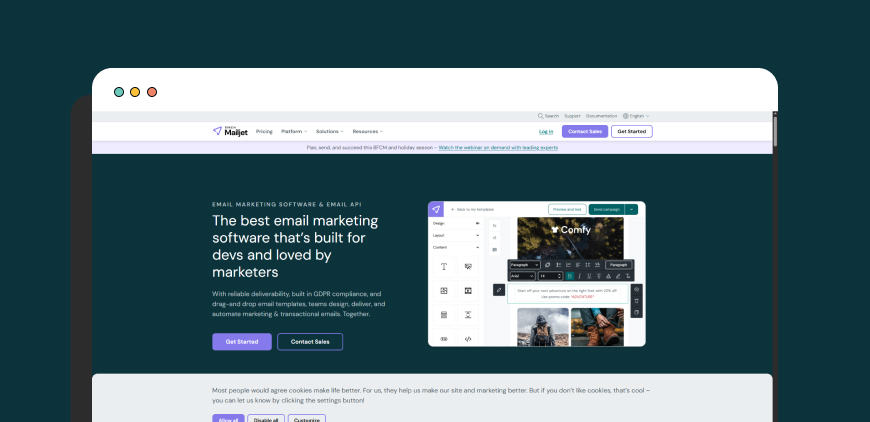
Mailjet’s unlimited contact storage makes it stand out for teams with large lists who send infrequently. The email API is developer-friendly, transactional email support is strong, and the deliverability infrastructure is reliable at scale. The collaborative email builder also allows multiple team members to work on templates simultaneously.
Advanced marketing automation is limited to a trial period on the free plan, and segmentation is not available without upgrading. For pure marketing automation, Brevo or MailerLite offers more. For high-volume transactional or API-driven sends, Mailjet earns its place.
| Free plan | Yes — unlimited contacts, 6,000 emails/month (200/day) |
| Starting price | $15/month |
| G2 rating | 4.0 / 5 (500+ reviews) |
| Best for | Businesses sending large volumes of transactional and marketing email |
19. Zoho Campaigns — Best for Zoho CRM Users
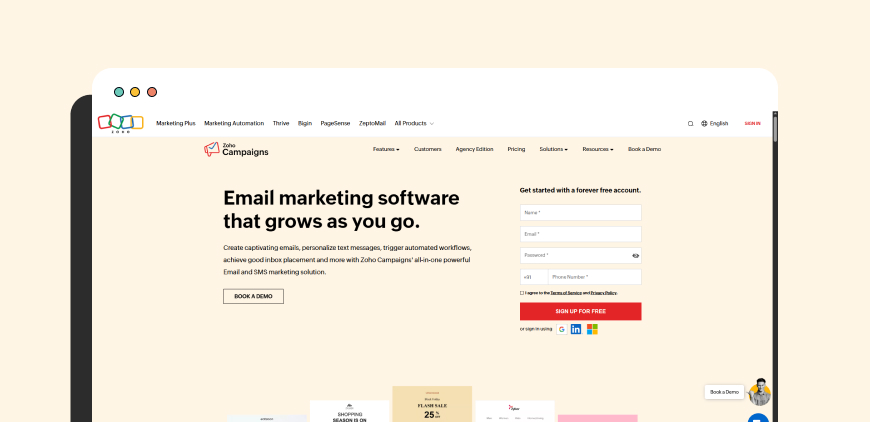
Zoho Campaigns is the logical email marketing choice for teams embedded in the Zoho ecosystem. The CRM sync is native and seamless, and the pricing is among the most affordable in this list at $5/month starting. Up to 5 users are supported even on the free plan.
Outside the Zoho ecosystem, the platform loses its main advantage. Automation is absent on the free plan, there is no A/B testing, and the interface feels less polished than MailerLite or Brevo. For Zoho users: it is an obvious choice. For everyone else: look elsewhere.
| Free plan | Yes — 2,000 contacts, 6,000 emails/month |
| Starting price | $5/month |
| G2 rating | 4.3 / 5 (200+ reviews) |
| Best for | Businesses already using Zoho CRM or other Zoho apps |
20. CleverReach — Best for EU GDPR Compliance
CleverReach hosts all data within the European Union and is built from the ground up with GDPR compliance at its core. For EU businesses in regulated industries — finance, healthcare, professional services — this is a significant differentiator. The automation builder is capable, and the campaign calendar is a useful planning feature.
The free plan is very limited (250 contacts, 1,000 emails) and all emails carry branding. Template variety is narrower than most competitors, and the platform is relatively unknown outside European markets. For the specific use case of EU data compliance, it is the best option. For general use, most businesses will find better value in Brevo (also EU-based) or MailerLite.
| Free plan | Yes — 250 contacts, 1,000 emails/month |
| Starting price | €15/month |
| G2 rating | 4.2 / 5 (250+ reviews) |
| Best for | EU-based businesses with strict data residency and GDPR compliance requirements |
What to Look for in Email Marketing Software in 2026
1. Deliverability first
Your emails cannot drive revenue if they land in spam. Before any other feature, check whether the platform offers domain authentication support (SPF, DKIM, DMARC), what their shared IP reputation is, whether dedicated IPs are available, and whether they publish deliverability transparency reports.
2. Automation that matches your complexity
A solopreneur sending a monthly newsletter needs a welcome email and nothing more. A SaaS company running trial conversion sequences needs conditional branching, behaviour triggers, and CRM sync. Be honest about where you sit on that spectrum before choosing.
3. Pricing that scales without shocks
Most platforms look affordable at 500 contacts. The test is what happens at 10,000 or 50,000. Calculate the cost at 3x your current list size before committing. Brevo (volume-based) and Moosend (contact-based but affordable) tend to scale most predictably. Mailchimp and Klaviyo can become expensive quickly.
4. Integrations with your existing stack
A platform with 800 integrations is worthless if it does not connect to your specific CRM, ecommerce platform, or CMS. Prioritise direct native integrations over Zapier workarounds — they are more reliable and require less maintenance.
5. Support quality matched to your team
If your team has no email marketing experience, live chat onboarding support is worth paying for. If you are technical and self-sufficient, documentation quality matters more than chat availability. AWeber and Constant Contact stand out for support access. Mailchimp and MailerLite have extensive self-service resources. If you’re comparing these two directly, see our in-depth Constant Contact vs Mailchimp comparison.
Final Verdict: Which Email Marketing Software is Best for You?
There is no single best tool — the right platform depends entirely on your use case, team size, and budget. Here is a quick decision guide:
- Best overall for small businesses and SMBs: Mailercloud or MailerLite — both offer advanced features at accessible prices
- Best for ecommerce (Shopify/WooCommerce): Klaviyo for advanced stores, Omnisend for budget-conscious multichannel
- Best free plan for creators and newsletters: ConvertKit (Kit) or Beehiiv
- Best for CRM-led teams: Best for CRM-led teams: HubSpot (free CRM) or Brevo (built-in CRM at low cost). Teams that need a structured process for handling sales-ready prospects after email engagement can also follow effective lead management practices to organise, prioritise, and follow up with leads. For more options, explore our roundup of Brevo alternatives.
- Best for advanced automation: ActiveCampaign — there is no close second
- Best for high-volume sending: SendPulse (free tier) or Mailjet (unlimited contacts)
- Best for EU compliance: CleverReach or Brevo (EU-hosted infrastructure)
FAQ
What is the best email marketing software overall in 2026?
There is no universal answer — it depends on your use case. For small businesses and SMBs on a budget, Mailercloud and MailerLite offer the best combination of features and affordability. For ecommerce, Klaviyo or Omnisend lead. For advanced automation, ActiveCampaign. For teams needing a CRM built in, Brevo or HubSpot. See how they stack up in our Omnisend vs Klaviyo comparison for ecommerce.
Is Mailchimp still the best email marketing tool?
Mailchimp is the most well-known, but it is no longer the best on most measures. Its free plan has been significantly reduced, pricing scales steeply, and automation is paywalled. Tools like Brevo, MailerLite, and Moosend offer more features for less money. Mailchimp remains strongest for teams deeply integrated into its 800+ app ecosystem.
Which email marketing platform has the best deliverability?
Mailercloud,ActiveCampaign, Klaviyo, and Mailjet have strong reputations for deliverability. Deliverability is also affected by your own sender practices — list hygiene, authentication setup (SPF, DKIM, DMARC), and engagement rates matter as much as the platform’s infrastructure.
What is the best free email marketing software?
For pure volume: SendPulse (15,000 emails/month free). For contacts: ConvertKit (10,000 subscribers free). For automation: Brevo or Mailercloud (both include automation on free plans). For simplicity: MailerLite (1,000 contacts, polished UI, free landing pages).
Which email marketing tool is best for Shopify stores?
Klaviyo is the market leader for Shopify email marketing — its native integration pulls product, order, and browse data enabling highly personalised automation. Omnisend is the best alternative if Klaviyo’s pricing is a concern. For very small stores, Mailchimp and MailerLite also have functional Shopify integrations. For a direct face-off, read our Klaviyo vs Mailchimp head-to-head.
What is the most affordable email marketing software?
Moosend starts at $9/month with no feature restrictions. Zoho Campaigns starts at $5/month. Brevo is effectively free until you send more than 9,000 emails per month. Mailercloud starts at $10/month with a competitive free plan included.
What should I look for in an email marketing platform for a SaaS company?
SaaS companies need behaviour-based automation triggered by in-app events (trial started, feature used, upgrade prompt), CRM sync for sales handoff, and strong transactional email support. ActiveCampaign and Brevo are the strongest options. Mailercloud’s AMP email support is also a differentiator for interactive in-email experiences.
How many emails can I send for free?
Free plan send limits vary significantly: SendPulse (15,000/month), MailerLite (12,000/month), Brevo (9,000/month / 300 per day), Mailjet (6,000/month / 200 per day), Zoho Campaigns (6,000/month), HubSpot (2,000/month), Mailchimp (1,000/month).
Can I switch email marketing platforms without losing my list?
Yes. All major platforms allow you to export your contact list as a CSV and import it elsewhere. You will need to re-authenticate your domain on the new platform (update SPF/DKIM records) and may want to warm up your sending gradually on the new infrastructure. Most platforms offer migration assistance — ActiveCampaign, HubSpot, and Brevo all have dedicated migration support.
What is the difference between email marketing software and marketing automation software?
Email marketing software focuses on creating, sending, and tracking email campaigns. Marketing automation software extends that to include behaviour-triggered sequences, CRM integration, lead scoring, and cross-channel workflows. Tools like ActiveCampaign, HubSpot, and Brevo sit in the automation category. Tools like MailerLite and Mailchimp are primarily email marketing tools with some automation features. If automation is the deciding factor, we have 12 automation platforms compared on what each plan actually permits.

As a Marketing Director, I develop and implement marketing strategies, conduct market research, and manage a team of marketing professionals. With a successful track record of launching campaigns that drive revenue growth, I bring my marketing expertise to blog writing, creating engaging content that promotes the brand and its products/services.